





















Content ITV PRO
This is Itvedant Content department
Learning Outcome\
5
Ensure timely updates for accurate NAV.
4
Calculate changes in shares and value.
3
Understand post-action portfolio updates
2
Differentiate Dividend, Bonus, Rights, and Stock Split.
1
Explain corporate actions' impact on fund holdings.
Corporate Actions Processing
Each corporate action affects a fund's holdings in a different way. Some add cash (dividends), some add free shares (bonus issues), some allow investors to buy additional shares (rights issues), and some increase the number of shares without changing the investment value (stock splits). The back-office team must update the number of shares, their price, and the portfolio value correctly so that the fund's records and NAV remain accurate.
A Dividend is a cash payout a company makes to its shareholders out of profits, per share held. On the record date, the fund becomes entitled to the dividend and accrues it as income, even though the cash may be received a few weeks later. The share price typically falls by roughly the dividend amount on the ex-dividend date.
Dividend
Reliance Industries declares an interim dividend of ₹8 per share. Every fund holding Reliance shares on the record date becomes entitled to receive ₹8 per share, credited to the fund's income.
Bonus Issue
A Bonus Issue is a free allotment of additional shares to existing shareholders in a fixed ratio (e.g., 1:1), funded out of the company's reserves rather than fresh cash. No money changes hands, and the share price falls proportionally so that the total value of the holding stays the same — only the number of shares held increases.
Infosys announces a bonus issue in the ratio 1:1. A shareholder holding 100 shares receives 100 additional shares free, ending up with 200 shares.
Rights Issue
A Rights Issue gives existing shareholders the right (not the obligation) to buy additional shares, in proportion to their current holding, at a price usually lower than the market price. Unlike a bonus issue, this brings fresh cash into the company, and a fund must actually pay for the new shares if it chooses to subscribe.
A fund holds 5,000 shares of PQR Ltd at a market price of ₹150. The company announces a 1:5 rights issue at ₹100 per share.
Formulae: Existing shares held X New shares offered/Existing shares required
Entitlement = 5,000 X 1/5 = 1,000 shares.
If the fund subscribes, additional investment = 1,000 × ₹100 = ₹1,00,000.
New holding = 6,000 shares. Blended (ex-rights) value per share = (5,000 × ₹150 + 1,000 × ₹100) ÷ 6,000 = ₹8,50,000 ÷ 6,000 = ₹141.67 per share.
Stock Split
A Stock Split divides each existing share into two or more shares of a smaller face value (e.g., one ₹10 face-value share becomes two ₹5 face-value shares), usually to improve affordability and liquidity. Like a bonus issue, no cash is involved — only the number of shares and the per-share price change, while the total holding value stays the same.
A company splits its ₹10 face-value share into two ₹5 face-value shares (a 1:2 split) to make the stock more affordable to smaller investors and improve trading liquidity
Portfolio Updates After Corporate Actions
Once a corporate action takes effect, the fund's back office must update its portfolio system — the quantity held, the average cost per share, and the market value — so that its own records match the custodian's and registrar's records, and NAV is calculated on the correct holding. This update must be completed before the next NAV cut-off, or the fund's NAV will be based on outdated positions.
After a bonus issue is credited by the depository, the custodian's holding statement shows the increased share count. The fund's operations team must update its own portfolio system to match this new quantity and revised price before the next NAV is struck.
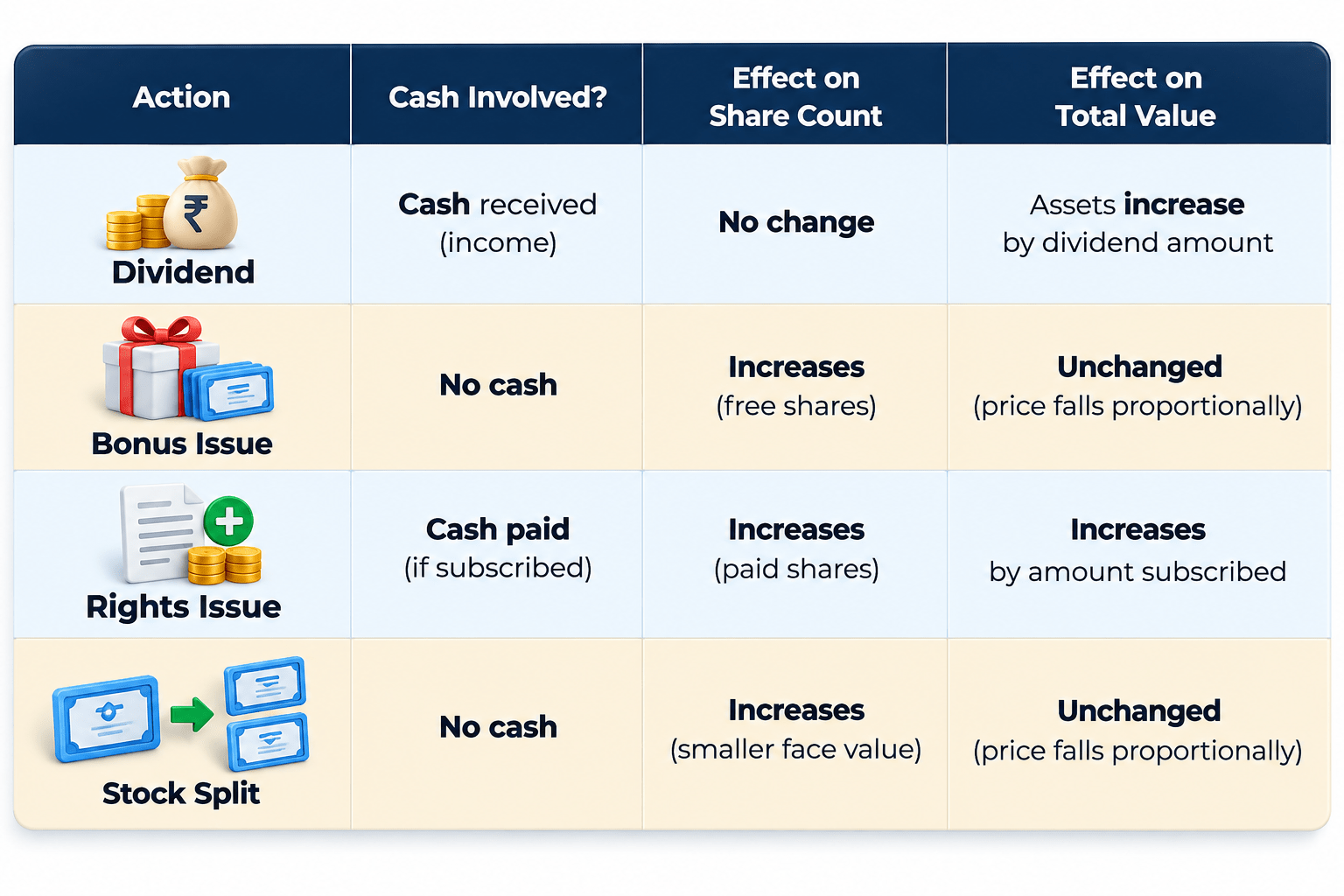
At a Glance — Comparing the Four Actions
Summary
5
Update records before NAV calculation.
4
Stock Splits increase shares, reduce price.
3
Rights Issues offer discounted shares.
2
Dividends add cash; Bonuses add shares.
1
Corporate actions affect fund holdings.
Quiz
Which corporate action requires shareholders to invest additional money if they choose to participate?
A. Dividend
B. Bonus Issue
C. Rights Issue
D. Stock Split
Quiz-Answer
Which corporate action requires shareholders to invest additional money if they choose to participate?
A. Dividend
B. Bonus Issue
C. Rights Issue
D. Stock Split
By Content ITV