
Content ITV PRO
This is Itvedant Content department
Performance Marketing & Ad Content
Business Scenario
Welcome back, Digital Marketing Executive!
Great job completing the first task.
You now understand where to market.
But a real Digital Marketer doesn’t stop there…
The next step is understanding how to use these channels effectively.
Because in Digital Marketing…
Knowing channels is not enough
Pre-Lab Preparation
Topic : Performance Marketing
1) Digital Marketing vs Performance Marketing
2) Paid Ads Objective
3) Performance Marketing KPIs
4) Landing vs Website Pages
5) Remarketing and Conversion
6) Strategies to Create Converting Banner & Video for the Ad
Task 1: Performance Marketing Fundamentals
1
Understand Digital vs Performance Marketing
In this Task, you will learn how to:
Let Us Understand this task with the help of a case study of Savannah Restaurant
For Savannah Restaurant:
Digital Marketing = Overall presence (SEO, social media, content)
Performance Marketing = Paid campaigns focused on results (ads driving orders, leads)
Insight: Savannah uses Instagram for branding (digital), but runs ads for orders (performance)
2
Identify Ad Objectives
Ask:
What does Savannah want from ads?
Possible objectives:
Example:
Savannah runs Instagram ads for a “Weekend Combo Offer”
Objective = Increase conversions (orders)
3
Define KPIs (Key Performance Indicators)
Ask: How will Savannah measure success?
Common KPIs:
Example: If Savannah spends ₹1000 and gets 20 orders → KPI = Cost per order
Activity
Task 2 : Ad Content & Conversion Strategy
Compare landing vs website; design ads & remarketing ideas
In this activity, you will learn:
Landing Page vs Website Comparison
Remarketing concepts
Creating high-converting ads content
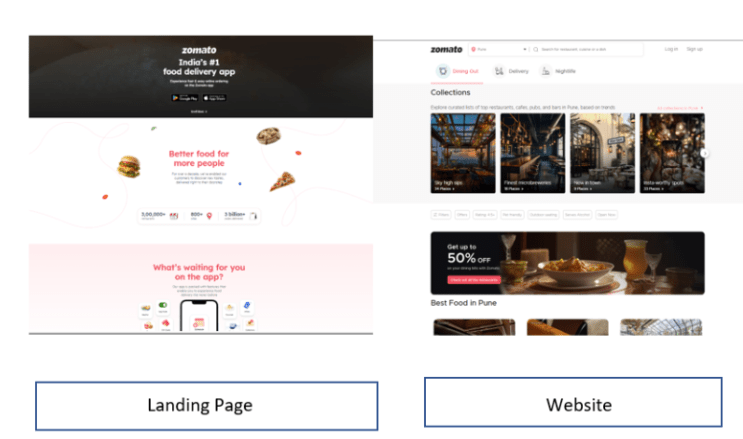
Let us understand this with the example of Zomato Website and Landing page .
1
Landing Page vs Website Comparison
Now apply the same steps:
For Zomato:
Website = General information (menu, about, contact)
Landing Page = Focused page for one goal (offer/order)
2
Understand Remarketing
Ask: What about users who didn’t order?
Eg. Zomato Strategy:
Show ads again to users who visited website
Offer discount to bring them back
Example:
“Still thinking? Get 10% off on your first order!”
3
Create Converting Ad Ideas
Eg. For Zomato:
Banner Ad Idea:
Visual: Delicious food image
Text: “Flat 20% Off Today!”
CTA: Order Now
Video Ad Idea:
Short reel showing food preparation
Customer reactions
Ending with offer
Focus:
Clear offer
Strong visuals
Strong CTA
Activity
Suggest 1 remarketing idea
Create:
1 Banner Ad concept
1 Video Ad concept
Now apply for Spice Garden:
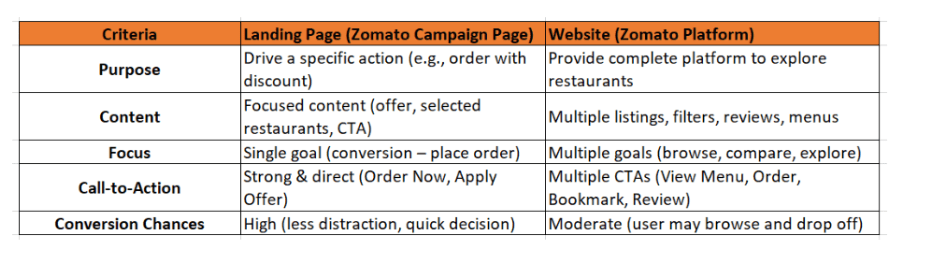
Compare landing page vs website usage , Note down the differences in the below table format :
Congratulations!
You have successfully completed the Performance Marketing & Ad Content
What You Learned :
Digital vs performance marketing differ in focus—branding vs measurable results.
Clear ad objectives and KPIs are essential to track success.
Landing pages are conversion-focused, unlike general websites.
Remarketing and strong ad design improve conversions.
Checkpoint
Next-Lab Preparation
Topic : Designing with Canva
1) - Logo Designing
2) Instagram Ad Creative
By Content ITV