






Mike Nason PRO
Open Scholarship and Publishing Librarian @ UNB Libraries // Metadata Nag and DOI Wrangler @ PKP // General Loudmouth and Malcontent
A webinar from the Public Knowledge Project
Mike Nason | Open Scholarship & Publishing Librarian @ UNB Libraries
Open Scholarly Infrastructure Advisor @ Public Knowledge Project (PKP)
Müge Bakioğlu | Publication Support Specialist, PKP
PKP is a software development and research facility at Simon Fraser University.
Since 1998, PKP's mission has been to research, develop, and support open infrastructure to increase the quality, diversity, and reach of scholarly publishing.
The Public Knowledge Project develops open source software which is used around the world for scholar-led, community driven publishing of journals, preprints, and monographs.
A system for authors to submit to a scholarly journal, track their submission through the editorial process, upload revisions, and publish, often open access.
A system for editors to manage submissions at different stages, track manuscript versions, and manage comms between authors, editors, and reviewers.
A system for reviewers to accept or decline peer review requests, see submissions, communicate with editors, and submit peer review materials.
A customizable, multilingual publication website with built-in indexing, dissemination, and preservation tools.
PKP software is developed, maintained, and sustained by a global community of developers, users, translators, financial contributors, and strategic partners.
PKP Provides resources to help our software users build their knowledge and enhance their scholarly publishing practices.
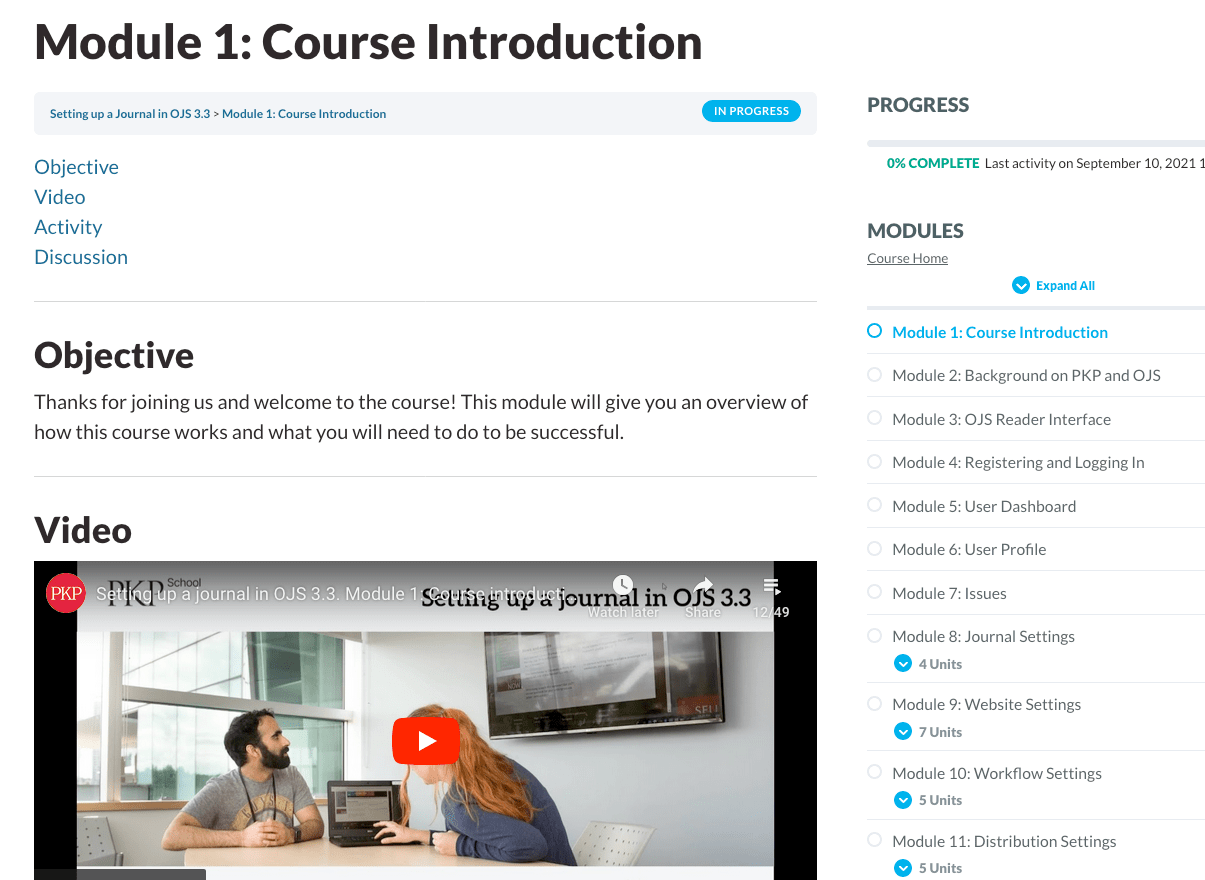
PKP also builds and maintains PKP School, a set of online, open, self-paced courses designed to help users understand how to use the software, participate in scholarly publishing, and improve the quality of scholarly publishing around the world.
We're going to talk about which version of OJS your journal should use, why it matters, and some of the reasons you should consider updating sooner-than-later to the latest "long term release" version of the software, OJS 3.5.
The quality of your metadata is so important for the indexing, discoverability, and success of your journal. We're going to talk about resources for best practices, how to find/fix metadata in your journal, and discuss the journey your metadata takes when you click the "publish" button in OJS.
What open scholarly infrastructure is, and why it matters for journals to be connected to it.
We'll also talk about where to find settings, populate policies, and how best to set your journal up for success.
Out of the box, Open Journal Systems is hugely supportive of open scholarly infrastructure. In fact, OJS is an example of open scholarly infrastructure, which we'll talk about here in a minute.
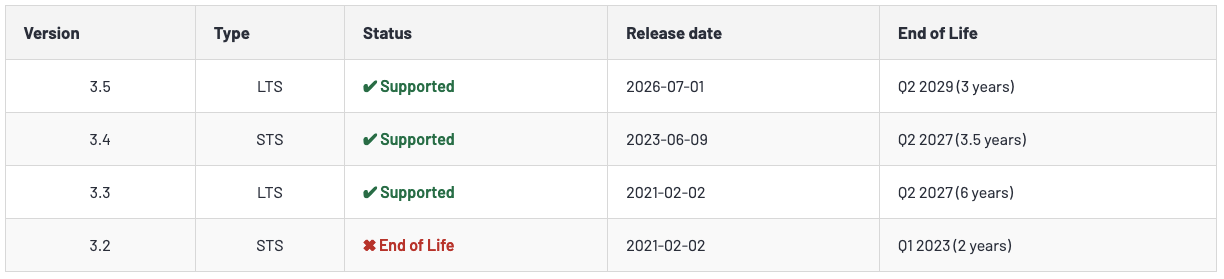
Today's webinar is going to be using a more recent version of OJS. If you're leveraging PIDs and other connections to open infrastructure, it's likely best to stay updated to, at least, the latest Long Term Support (LTS) version.
PREVIOUS LTS VERSION
LARGE INSTALL BASE
BIG SELECTION OF 3RD PARTY PLUGINS
DOI DEPOSIT BY PLUGIN
WILL BE FLAGGED FOR EOL WITHIN A YEAR AFTER OJS 3.5 GETS LTS DISIGNATION
MOST RECENT RELEASE
BETTER METADATA SUPPORT
SIGNIFICANT IMPROVEMENT TO PUBLISHING WORKFLOW
SIGNIFICANT UI IMPROVEMENTS
BROUGHT A NUMBER OF CHANGES TO STATISTICS, USER MANAGEMENT, AND SUBMISSION WORKFLOWS
MORE ITERATIVE FEATURES
DOI MANAGEMENT/DEPOSIT WORKFLOWS OVERHAULED
BROUGHT A NUMBER OF CHANGES TO STATISTICS, USER MANAGEMENT, AND SUBMISSION WORKFLOWS
MORE ITERATIVE FEATURES
DOI MANAGEMENT/DEPOSIT WORKFLOWS OVERHAULED
At an absolute minimum, I'd recommend running the latest version of OJS 3.3 to make sure you've got all the latest patches and security updates.
But, with the release of OJS 3.5 and it's updated status as the new LTS version of OJS, you should be planning to update as soon as you can.
Staying up to date on the LTS version is good practice and will help ensure a stable, secure platform for your journal.
That depends! Your experience with the software will be different depending on the version you have installed. Often, the tradeoff for newer versions of a platform is that you get the best, newest features but also need to apply more frequent updates to keep things secure and bug-free.
However, if you're currently on a version of OJS 3.2 or older, it matters a great deal. You should definitely – at least – upgrade to the latest version of OJS 3.3, and, better yet OJS 3.5.
OJS 3.2 is no longer supported and you'll be missing out on security updates and bug fixes.
If you're on 3.3 and are happy with how things are, you should still consider upgrading to OJS 3.5.
OJS 3.3 will no longer receive support or security updates and patch fixes after Q2 of 2027*.
I'd like to start with an example that I think will help ground our understanding.
We'll start by talking about the DOI.
It's a little difficult to talk about open scholarly infrastructure in a broad sense.
A government building, power grid, education system, or network of roadways are all traditional examples of things we call "infrastructure". But they are each unique.
DOIs are ubiquitous. We see them all over the place:
Barr, S. M., White, C. E., & Pin, C. (2022). Revised stratigraphy in the eastern Meguma terrane, Nova Scotia, Canada, and variations in whole-rock chemical and Sm–Nd isotopic compositions of the Goldenville and Halifax groups. Atlantic Geoscience, 58, 193–213. https://doi.org/10.4138/atlgeo.2022.008
And, we probably know one handy thing about them:
If you click on a DOI that looks like a link, it will take you to the thing.
DOIs are the most prominent persistent identifier.
They are also, arguably, the most important persistent identifier.
A DOI is made up of two chunks. A prefix, and a suffix.
prefix
10.4324
suffix
9780203051238-5
Together, these make the DOI 10.4324/9780203051238-5
Prefixes and suffixes mean different things.
prefix
10.4324
A prefix is usually associated with a publisher or organization. DOIs for that organization will usually have the same prefix.
suffix
9780203051238-5
A suffix is meant to be a machine-readable (not human-readable), opaque, unique string that is specific to the singular work to which it is assigned.
prefix
10.4138
This prefix is held by Crossref member, Atlantic Geoscience, a journal we host at my home institution.
suffix
atlgeol.2022.008
You can see here that their suffixes follow a pattern, and you can probably guess that pattern. This is very common, despite being both unnecessary and discouraged.
If I prepend a DOI with https://doi.org/, it turns into a URL.
https://doi.org/10.4138/atlgeol.2022.008
Clicking this will redirect me to the publication this DOI is associated with.
> The process of a DOI redirecting you to a publication is called resolution.
DOIs aren't just like a bit.ly link or tiny.url. If you're not familiar with these services, they will swap out a very large and unwieldy link so you can share something that isn't enormous.
For example: https://bit.ly/48fy2pZ
This 👆 is a bit.ly link for this talk.
The actual URL for this talk is: https://slides.com/ahemnason/pids-ojs/
bit.ly and tiny.url are both basic redirects.
But, plenty of people treat DOIs this way, or assume it's their only real function.
Or, they make some sort of wild assumption that DOIs are some sort of certification or other proof that research/publishers are trustworthy.
A DOI, though, is a lot more than a redirect. A DOI is a reference to an entire publication record. That publication record is full of metadata.
And, one of these metadata elements is the publication's URL.
When you resolve a DOI by clicking on it:
The URL can be updated by the publisher. The DOI stays the same.
<?xml version="1.0" encoding="UTF-8"?>
<crossref_result version="3.0" xsi:schemaLocation="http://www.crossref.org/qrschema/3.0 http://www.crossref.org/schemas/crossref_query_output3.0.xsd">
  <query_result>
    <head>
      <doi_batch_id>none</doi_batch_id>
    </head>
    <body>
      <query status="resolved">
        <doi type="book_content">10.4324/9780203051238-5</doi>
        <crm-item name="publisher-name" type="string">Informa UK Limited</crm-item>
        <crm-item name="prefix-name" type="string">Informa UK (Routledge)</crm-item>
        <crm-item name="member-id" type="number">301</crm-item>
        <crm-item name="citation-id" type="number">122425695</crm-item>
        <crm-item name="book-id" type="number">1477192</crm-item>
        <crm-item name="deposit-timestamp" type="number">2020122110554080199</crm-item>
        <crm-item name="owner-prefix" type="string">10.4324</crm-item>
        <crm-item name="last-update" type="date">2020-12-21T15:07:00Z</crm-item>
        <crm-item name="created" type="date">2020-12-21T15:06:59Z</crm-item>
        <crm-item name="citedby-count" type="number">0</crm-item>
        <doi_record>
          <crossref xsi:schemaLocation="http://www.crossref.org/xschema/1.1 http://doi.crossref.org/schemas/unixref1.1.xsd">
            <book book_type="other">
              <book_metadata language="en">
                <contributors>
                  <person_name sequence="first" contributor_role="author">
                    <given_name>Richard</given_name>
                    <surname>Smiraglia</surname>
                  </person_name>
                </contributors>
                <titles>
                  <title>Metadata</title>
                  <subtitle>A Cataloger's Primer</subtitle>
                </titles>
                <edition_number>0</edition_number>
                <publication_date media_type="online">
                  <month>11</month>
                  <day>12</day>
                  <year>2012</year>
                </publication_date>
                <isbn media_type="electronic">9780203051238</isbn>
                <publisher>
                  <publisher_name>Routledge</publisher_name>
                </publisher>
                <doi_data>
                  <doi>10.4324/9780203051238</doi>
                  <timestamp>2020122110554078499</timestamp>
                  <resource>https://www.taylorfrancis.com/books/9781136435843</resource>
                </doi_data>
              </book_metadata>
              <content_item component_type="chapter" publication_type="full_text" language="en">
                <titles>
                  <title>Understanding Metadata and Metadata Schemes</title>
                </titles>
                <publication_date>
                  <year>2012</year>
                  <month>11</month>
                  <day>12</day>
                </publication_date>
                <pages>
                  <first_page>25</first_page>
                  <last_page>44</last_page>
                </pages>
                <doi_data>
                  <doi>10.4324/9780203051238-5</doi>
                  <timestamp>2020122110554080199</timestamp>
                  <resource>https://www.taylorfrancis.com/books/9781136435843/chapters/10.4324/9780203051238-5</resource>
                </doi_data>
              </content_item>
            </book>
          </crossref>
        </doi_record>
      </query>
    </body>
  </query_result>
</crossref_result>
I'm sorry to do this to you.
There's a lot of information here:
publisher
deposit and update timestamp
book type
contributors (first, role=author)
title and subtitle
publication date
doi for the book
link for the book
chapter title
doi for the chapter
link for the chapter
<doi_data>
  <doi>10.4324/9780203051238</doi>
  <timestamp>2020122110554078499</timestamp>
  <resource>https://www.taylorfrancis.com/books/9781136435843</resource>
</doi_data>
</book_metadata>
<content_item component_type="chapter" publication_type="full_text" language="en">
  <titles>
    <title>Understanding Metadata and Metadata Schemes</title>
  </titles>
  <publication_date>
    <year>2012</year>
    <month>11</month>
    <day>12</day>
  </publication_date>
  <pages>
    <first_page>25</first_page>
    <last_page>44</last_page>
  </pages>
  <doi_data>
    <doi>10.4324/9780203051238-5</doi>
    <timestamp>2020122110554080199</timestamp>
    <resource>https://www.taylorfrancis.com/books/9781136435843/chapters/10.4324/9780203051238-5</resource>
  </doi_data>


<!-- urls are part of the metadata of a doi. -->
<!-- when you change the location of content, you update your doi with the new location. everyone who uses the doi gets to the content no matter where you put it, so long as that doi is updated. this means, the doi is persistent.-->
Congratulations, you now know more about DOIs than a frankly surprising number of people.
And, by extension, you've now been exposed to the concept of open scholarly infrastructure.
A persistent identifier cannot work without some service or agency to facilitate the registration, data storage, and retrieval of all this information.
A third party is required. Infrastructure.
This is why we have PID registration agencies.
DOIs are an example of what we call "persistent identifiers" (PIDs).
PIDs are unique, unchanging, identifiers representing objects (digital or otherwise) that can direct a user, unambiguously, to that object's current location or status, and provide additional information/metadata.
They exist for all kinds of things! Publications, people, car registrations...
Registration agencies (typically international not-for-profits) store records/metadata, facilitate resolution requests, and may or may not offer other services based on membership.
There are a lot of registration agencies!
Each of these organizations is an example of open scholarly infrastructure.
Registration agencies provide metadata schema through which users can describe the objects they are registering PIDs for.
As you can imagine, you'd describe a person differently than you'd describe a dataset, or a journal article, or an organization. Even when agencies use the same type of PID (like the DOI), the schema they use may vary.
And that metadata is used by all kinds of other actors downstream of your publication. Things like:
Unlike publications themselves, metadata is typically free. And, we can learn a lot from it. Crossref, for example, can store the following things as publicly accessible metadata:
title
subtitle
authors
orcids
affiliation
copyright license
funder/grant ids
languages
ror
references
resource location
version
publisher
journal
volume/issue
related dois
dates
abstracts
Crossref makes this metadata available through a public API.
...is a network of scholarly-research-focused open-source platforms, service providers, and APIs that work in concert to share data, illuminate relationships, and make research more discoverable.
OpenAlex is a free and open catalog of the world's scholarly research system. It's a tool for broad publishing data, but it's also a tool for revealing connections between publications, institutions, funders, and researchers.
OpenAIRE is research output aggregator that harvests records for datasets, presentations, articles, proceedings and many other types of content. It pulls content from journals, publishers, repositories, and makes them searchable with any number of
The Directory of Open Access Journals is a well-known and crucial platform for the indexing and discovery of journals utilizing open access. It's not just a place to find a journal to publish in or look for open access materials, it's also a tool libraries can use in collection development.
All of these organizations push scholarly metadata around and make connections between them.
If you operate a journal, engaging with open scholarly infrastructure improves the discoverability of your journal significantly. It also makes it easier to see connections between funded research, outputs, and relationships between researchers and organizations. It's really good!
Crossref
DataCite
DOAJ
OpenAIRE
ROR
ORCID
DOCID
OpenAlex
Even OJS is an example of OSI. In fact, PKP are adopters of the principles of open scholarly infrastructure.
web crawlers (bots, etc.)
google scholar
subscription & rss
web crawlers (bots, etc.)
google scholar
subscription & rss
DOCID
OpenAlex
OpenAIRE
ORCID
web crawlers (bots, etc.)
google scholar
subscription & rss
DOCID
OpenAlex
OpenAIRE
ORCID
ORCID
ROR
DOAJ
OpenAlex
OpenAIRE
ORCID
The metadata we get out of these systems, and its utility, is very much dependent on its quality.
We have a general expression in the metadata universe. that's "garbage in, garbage out."
The metadata in your journal is the origin point for all of the downstream consumers of open scholarly infrastructure.
A typo here (or missing affiliation, all-caps title metadata, or author name errors) will be a typo everywhere else down the line.
Metadata is kind of everyone's responsibility. Researchers, librarians, publishers, registration agencies... everyone has a stake in accurate, usable metadata.
Forgive me for being presumptive, but there is a general expectation that you want people to see the products of your hard work.
You want your work to be known and discoverable; accessible to the folks who might benefit from it.
I would think (hope).
And, you'd probably like it to be attributed to you, since you did the work and also since the implications of its value will have some impact on your career or the career of your authors.
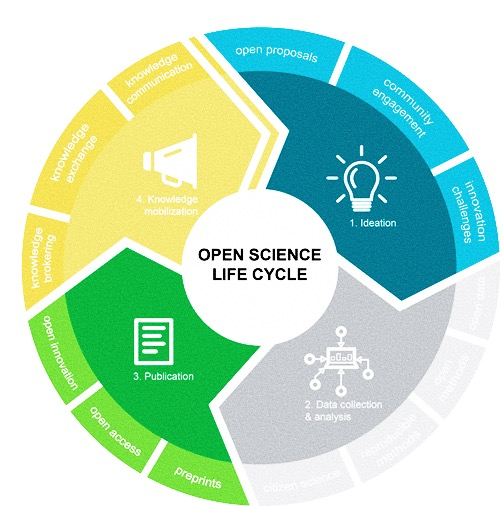
https://science.gc.ca/site/science/en/open-science
Publishing your work as a modern academic kicks off an enormous Rube Goldberg machine of scholarly publishing infrastructure. We're talking data, articles, preprints, presentations, proceedings, and countless other things.
This is important stuff for both a journal and for authors.
Authors will know what they worked on, for example, but people (researchers, funders, institutions, employers) looking for their work might not.
All researchers need to talk about the work they've done. Often. Repeatedly. And, all researchers benefit from clear, unambiguous attribution.
Your work is going to end up in a lot of places, often without you even really being aware of it.
If you manage a journal, you are standing at the nozzle of a metadata firehose.
Getting Found, Staying Found: Persistent Identifiers & Their Value | A webinar from PKP, 2024. (Deck, Video)
OJS, DOIs & Datacite | A webinar for DataCite & PKP, 2025. (Deck, Video)
By Mike Nason
Webinar from the Public Knowledge Project.