Ensemble Learning & Advanced ML Algorithms(Loan Default Prediction)


Gradient Boosting and XGBoost


Learning Outcome
5
Explore its key features
4
Understand XGBoost
3
Know its limitations
2
Learn error (residual) correction
1
Understand Gradient Boosting basics
Topic Name-Recall(Slide3)
Hook/Story/Analogy(Slide 4)
Transition from Analogy to Technical Concept(Slide 5)
The Math of the Sculptor
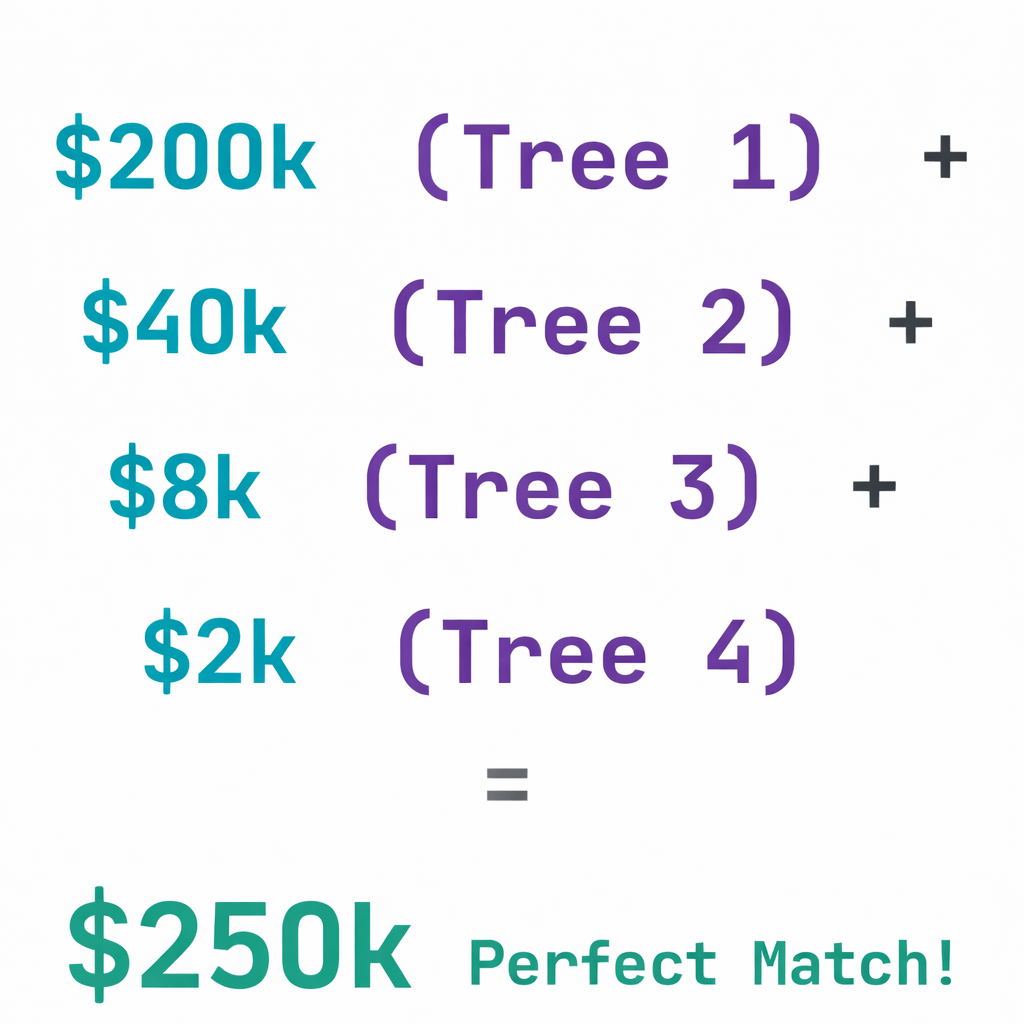
The Combination:
Final_Prediction = Model_1(Base) + Model_2(Error)
Step 1 :
Tree 1 predicts house price: $200k
Actual Price: $250k
The Residual (Error): $250k - $200k = +$50k
Step 2 :
Tree 2 does NOT predict $250k.
It explicitly targets the Residual (+$50k)
This is the key to Gradient Boosting!
To get our final prediction, we simply add the outputs together
The Problem: Standard Gradient Boosting is Fragile
Overfitting (Too Much Learning)
Slow Speed
Problem 1:
Problem 2:
- Gradient Boosting keeps adding trees again and again
- After a point, it starts learning noise (wrong patterns) instead of real data
- Like sculptor adding extra fake details → model becomes less general
- Trees are built one after another (sequentially)
- Next tree starts only after previous one finishes
- So it is hard to parallelize → very slow
The Evolution: Enter XGBoost
What is it?
Extreme Gradient Boosting
Takes the math of Gradient Boosting and injects hardware optimization, mathematical safety nets, and extreme speed.

Why "Extreme"? :
It enhances Gradient Boosting with speed, optimization, and better accuracy.
The King of ML :
Behind almost every winning Kaggle competition for tabular data

Why XGBoost is Best
Built-in Regularization
L1 & L2 Penalties
XGBoost controls model complexity and prevents overfitting by penalizing complex trees.
Acts as a strict manager
Sparsity Awareness
Handles Missing Data
XGBoost handles missing data automatically by learning the best path
No imputation required!
Does magic under the hood
XGBoost speeds up training by using parallel processing on multi-core systems.
Hardware Parallelization
Extreme Speed



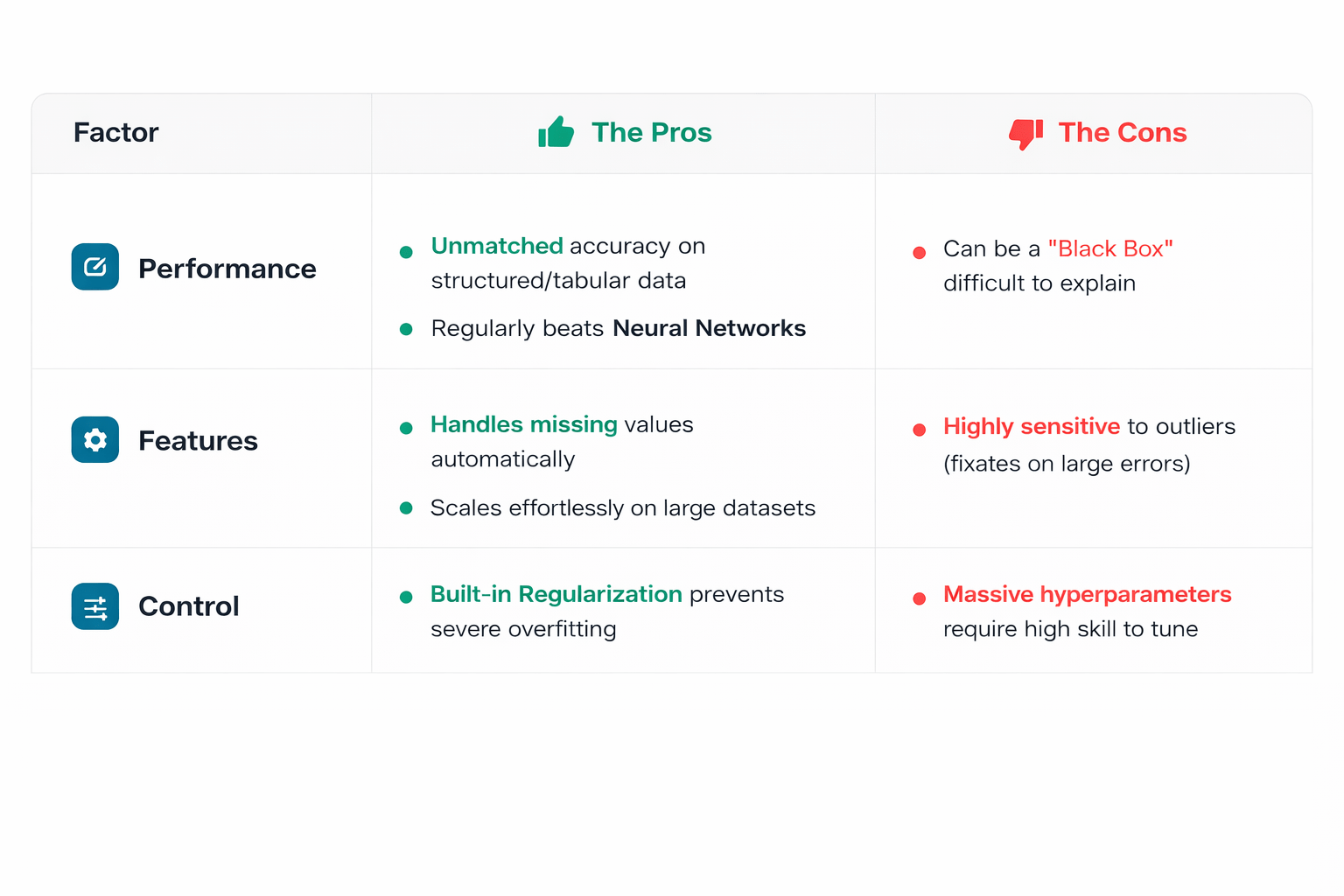
Pros & Cons Cheat Sheet
Summary
5
XGBoost handles missing data, regularization, and fast computation
4
XGBoost improves performance and efficiency
3
It can suffer from overfitting and slow speed
2
Each model predicts the error (residual) of the previous one
1
Gradient Boosting builds models sequentially
Quiz
What does the second tree predict in Gradient Boosting?
A. Same target
B. Average values
C. Residual (error)
D. Missing values

Quiz-Answer
What does the second tree predict in Gradient Boosting?
A. Same target
B. Average values
C. Residual (error)
D. Missing values